
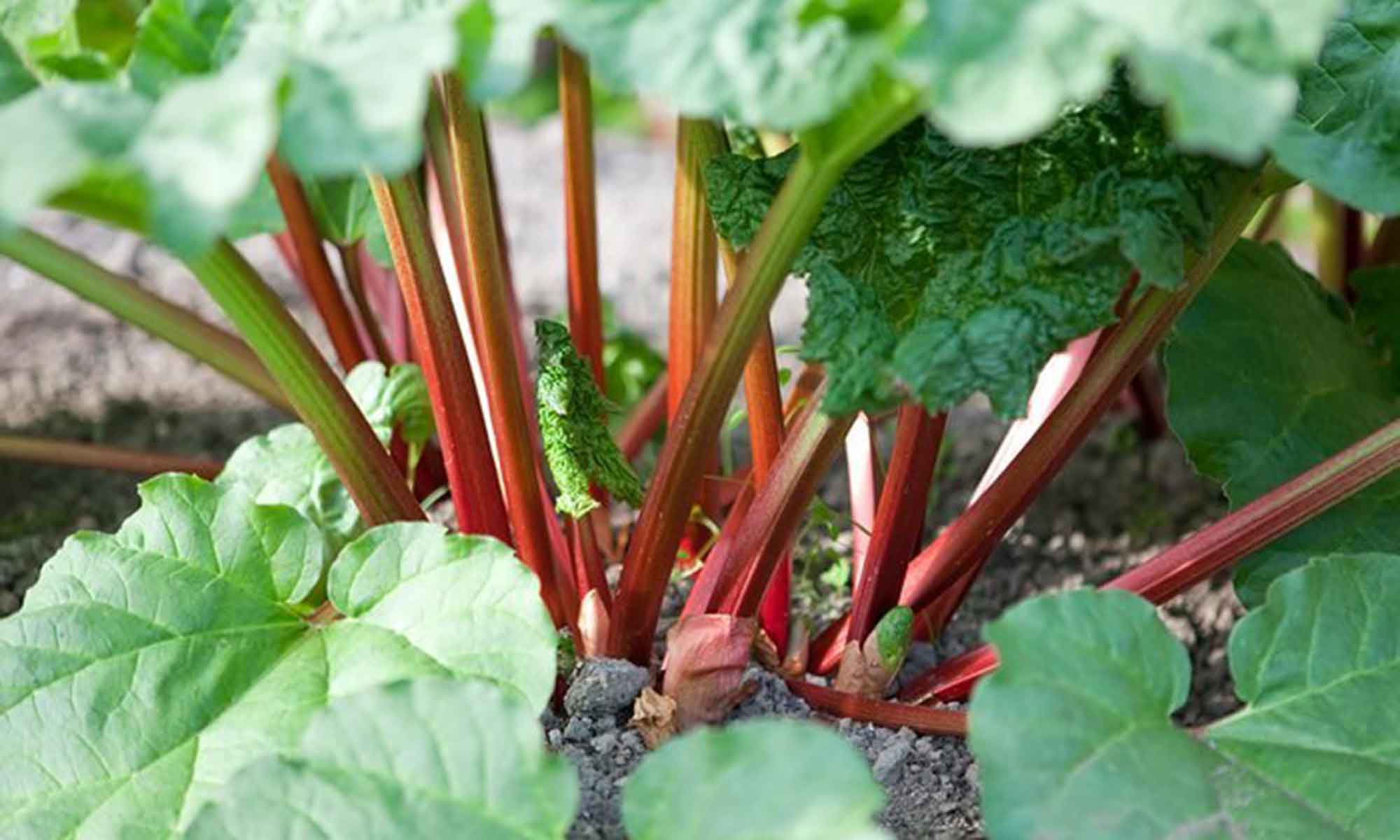
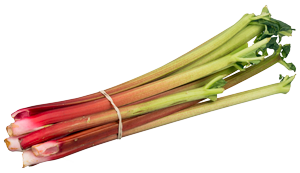
Rhubarb is the fleshy, edible stalks (petioles) of species and hybrids (culinary rhubarb) of Rheum in the family Polygonaceae, which are cooked and used for food. The whole plant – a herbaceous perennial growing from short, thick rhizomes – is also called rhubarb. Historically, different plants have been called “rhubarb” in English. The large, triangular leaves contain high levels of oxalic acid and anthrone glycosides, making them inedible. The small flowers are grouped in large compound leafy greenish-white to rose-red inflorescences.
The precise origin of culinary rhubarb is unknown. The species Rheum rhabarbarum (syn. R. undulatum) and R. rhaponticum were grown in Europe before the 18th century and used for medicinal purposes. By the early 18th century, these two species and a possible hybrid of unknown origin, R. × hybridum, were grown as vegetable crops in England and Scandinavia. They readily hybridize, and culinary rhubarb was developed by selecting open-pollinated seed, so its precise origin is almost impossible to determine.[3] In appearance, samples of culinary rhubarb vary on a continuum between R. rhaponticum and R. rhabarbarum. However, modern rhubarb cultivars are tetraploids with 2n = 44, in contrast to 2n = 22 for the wild species.
Although rhubarb is a vegetable, it is often put to the same culinary uses as fruits. The leaf stalks can be used raw, when they have a crisp texture (similar to celery, although it is in a different family), but are most commonly cooked with sugar and used in pies, crumbles and other desserts. They have a strong, tart taste. Many cultivars have been developed for human consumption, most of which are recognised as Rheum × hybridum by the Royal Horticultural Society
The Chinese call rhubarb “the great yellow” (dà huáng 大黃), and have used rhubarb root for medicinal purposes. It appears in The Divine Farmer’s Herb-Root Classic, which is thought to have been compiled about 1,800 years ago.[19] Though Dioscurides’ description of ρηον or ρά indicates that a medicinal root brought to Greece from beyond the Bosphorus may have been rhubarb, commerce in the plant did not become securely established until Islamic times. During Islamic times, it was imported along the Silk Road, reaching Europe in the 14th century through the ports of Aleppo and Smyrna, where it became known as “Turkish rhubarb”. Later, it also started arriving via the new maritime routes, or overland through Russia. The “Russian rhubarb” was the most valued, probably because of the rhubarb-specific quality control system maintained by the Russian Empire.
The cost of transportation across Asia made rhubarb expensive in medieval Europe. It was several times the price of other valuable herbs and spices such as cinnamon, opium, and saffron. The merchant explorer Marco Polo therefore searched for the place where the plant was grown and harvested, discovering that it was cultivated in the mountains of Tangut province. The value of rhubarb can be seen in Ruy Gonzáles de Clavijo’s report of his embassy in 1403–05 to Timur in Samarkand: “The best of all merchandise coming to Samarkand was from China: especially silks, satins, musk, rubies, diamonds, pearls, and rhubarb….”
The high price, as well as the increasing demand from apothecaries, stimulated efforts to cultivate the different species of rhubarb on European soil. Certain species came to be grown in England to produce the roots. The local availability of the plants grown for medicinal purposes, together with the increasing abundance and decreasing price of sugar in the 18th century, galvanised its culinary adoption.[21] Grieve claims a date of 1820 in England.[23] Rhubarb was harvested in Scotland from at least 1786, having been introduced to the Botanical Garden in Edinburgh by the traveller Bruce of Kinnaird in 1774. He brought the seeds from Abyssinia and they produced 3000 plants.
Though it is often asserted that rhubarb first came to the United States in the 1820s, John Bartram was growing medicinal and culinary rhubarbs in Philadelphia from the 1730s, planting seeds sent to him by Peter Collinson.[26] From the first, the familiar garden rhubarb was not the only Rheum in American gardens: Thomas Jefferson planted R. undulatum at Monticello in 1809 and 1811, observing that it was “Esculent rhubarb, the leaves excellent as Spinach.”
.
Leave a Reply