

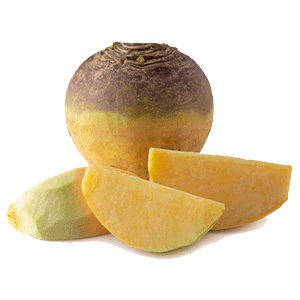
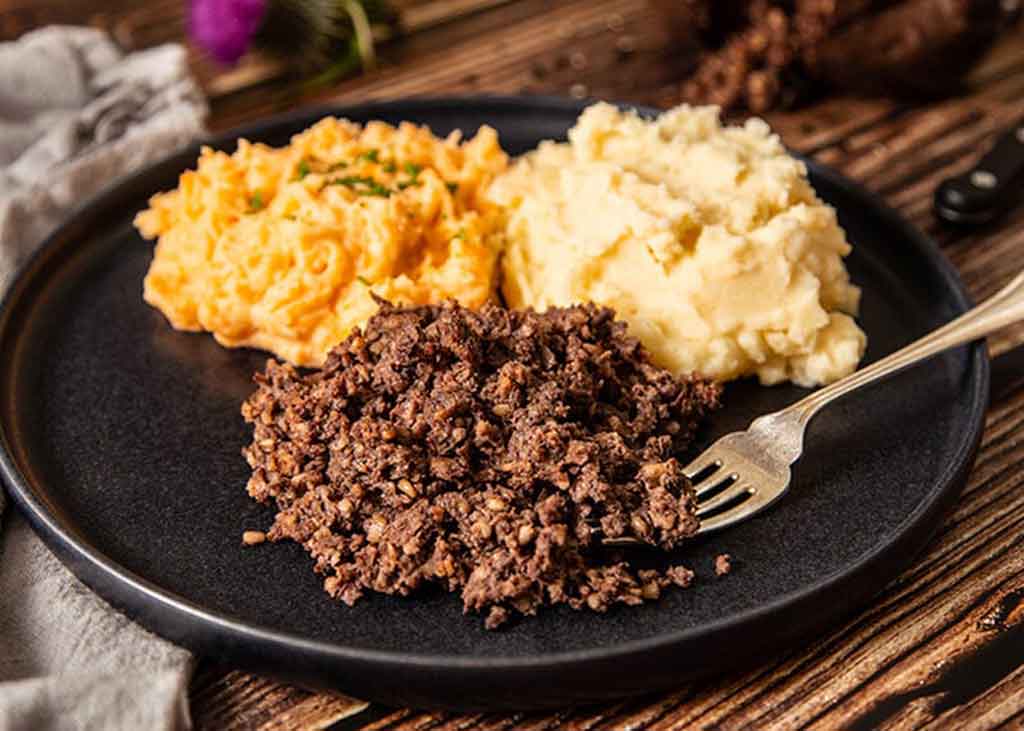
To the Scottish it is a Neep. To the English its a Swede. To the Americans it is Rutabaga. Neeps are a big root vegetable. It has a round shape and a purple-green skin, and the flesh is yellowy-orange, with a sweet, earthy flavour. Neeps are an important part of a Burns supper when haggis, neeps and tatties (potatoes) are served.
In Scotland, neeps are often fed to sheep when grass is scarce in winter. Sometimes, the sheep will be let into a field of neeps, still in the ground, and simply chomp their way through them.
Rutabaga (/ˌruːtəˈbeɪɡə/; North American English) or swede (British English and some Commonwealth English) is a root vegetable, a form of Brassica napus (which also includes rapeseed). Other names include Swedish turnip, neep (Scots), rwden/rwdins (Welsh), and turnip (Canadian English, Irish English and Manx English) – however, elsewhere the name “turnip” usually refers to the related white turnip. The species Brassica napus originated as a hybrid between the cabbage (Brassica oleracea) and the turnip (Brassica rapa). Rutabaga roots are eaten as human food in a variety of ways, and the leaves can be eaten as a leaf vegetable. The roots and tops are also used for livestock, either fed directly in the winter or foraged in the field during the other seasons. Scotland, Northern and Western England, Wales, the Isle of Man and Ireland had a tradition of carving the roots into lanterns at Halloween.
The first known printed reference to the rutabaga comes from the Swiss botanist Gaspard Bauhin in 1620, where he notes that it was growing wild in Sweden. It is often considered to have originated in Scandinavia, Finland or Russia. According to the Natural Resources Institute of Finland (Luke), rutabaga or lanttu was most likely bred on more than one occasion in Northern Europe, around the 16th century. Introduction to North America came in the early 19th century with reports of rutabaga crops in Illinois as early as 1817.
Rutabaga was once considered a food of last resort in both Germany and France due to its association with food shortages in World War I and World War II. Boiled stew with rutabaga and water as the only ingredients (Steckrübeneintopf) was a typical food in Germany during the famines and food shortages of World War I caused by the Allied blockade (the Steckrübenwinter or Turnip Winter of 1916–17) and between 1945 and 1949. As a result, many older Germans had unhappy memories of this food.
Leave a Reply