

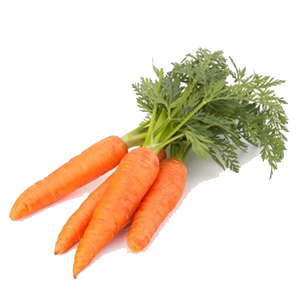
The carrot (Daucus carota subsp. sativus) is a root vegetable, typically orange in colour, though purple, black, red, white, and yellow cultivars exist, all of which are domesticated forms of the wild carrot, Daucus carota, native to Europe and Southwestern Asia. The plant probably originated in Persia and was originally cultivated for its leaves and seeds. The most commonly eaten part of the plant is the taproot, although the stems and leaves are also eaten. The domestic carrot has been selectively bred for its enlarged, more palatable, less woody-textured taproot.
The carrot is a biennial plant in the umbellifer family, Apiaceae. At first, it grows a rosette of leaves while building up the enlarged taproot. Fast-growing cultivars mature within three months (90 days) of sowing the seed, while slower-maturing cultivars need a month longer (120 days). The roots contain high quantities of alpha- and beta-carotene, and are a good source of vitamin A, vitamin K, and vitamin B6.
Both written history and molecular genetic studies indicate that the domestic carrot has a single origin in Central Asia. Its wild ancestors probably originated in Persia (regions of which are now Iran and Afghanistan), which remains the centre of diversity for the wild carrot Daucus carota. A naturally occurring subspecies of the wild carrot was presumably bred selectively over the centuries to reduce bitterness, increase sweetness and minimise the woody core; this process produced the familiar garden vegetable.
When they were first cultivated, carrots were grown for their aromatic leaves and seeds rather than their roots. Carrot seeds have been found in Switzerland and Southern Germany dating back to 2000–3000 BC. Some close relatives of the carrot are still grown for their leaves and seeds, such as parsley, cilantro, coriander, fennel, anise, dill and cumin. The first mention of the root in classical sources is from the 1st century AD; the Romans ate a root vegetable called pastinaca, which may have been either the carrot or the closely related parsnip.
The plant is depicted and described in the Eastern Roman Juliana Anicia Codex, a 6th-century AD Constantinopolitan copy of the Greek physician Dioscorides’ 1st-century pharmacopoeia of herbs and medicines, De Materia Medica. Three different types[clarification needed] of carrots are depicted, and the text states that “the root can be cooked and eaten”. Another copy of this work, Codex Neapolitanes from late 6th or early 7th century, has basically the same illustrations but with roots in purple.
The plant was introduced into Spain by the Moors in the 8th century. In the 10th century, roots from West Asia, India and Europe were purple. The modern carrot originated in Afghanistan at about this time. The 11th-century Jewish scholar Simeon Seth describes both red and yellow carrots,[19] as does the 12th-century Arab-Andalusian agriculturist, Ibn al-‘Awwam. Cultivated carrots appeared in China in the 12th century, and in Japan in the 16th or 17th century.
There are many claims that Dutch growers created orange carrots in the 17th century to honor the Dutch flag at the time and William of Orange. Other authorities argue these claims lack convincing evidence. Modern carrots were described at about this time by the English antiquary John Aubrey (1626–1697): “Carrots were first sown at Beckington in Somersetshire. Some very old Man there [in 1668] did remember their first bringing hither.” European settlers introduced the carrot to colonial America in the 17th century.
Outwardly purple carrots, still orange on the inside, were sold in British stores beginning in 2002.
The h World War II myt that carrots help you see in the dark isn’t too farfetched thanks to high levels of vitamin A being present in these delicious orange beauties. Carrots won’t give you pure night vision, but eating them will certainly help to keep your eyes healthy.
The myth that eating carrots gave you extra-terrestrial night vision was propagated by the Air Ministry during World War II. To prevent the Germans finding out that Britain was using radar to intercept bombers on night raids, they issued press releases stating that British pilots were eating lots of carrots to give them exceptional night vision. This fooled the British public, as well as German High Command and an old wive’s tale was born.
Leave a Reply